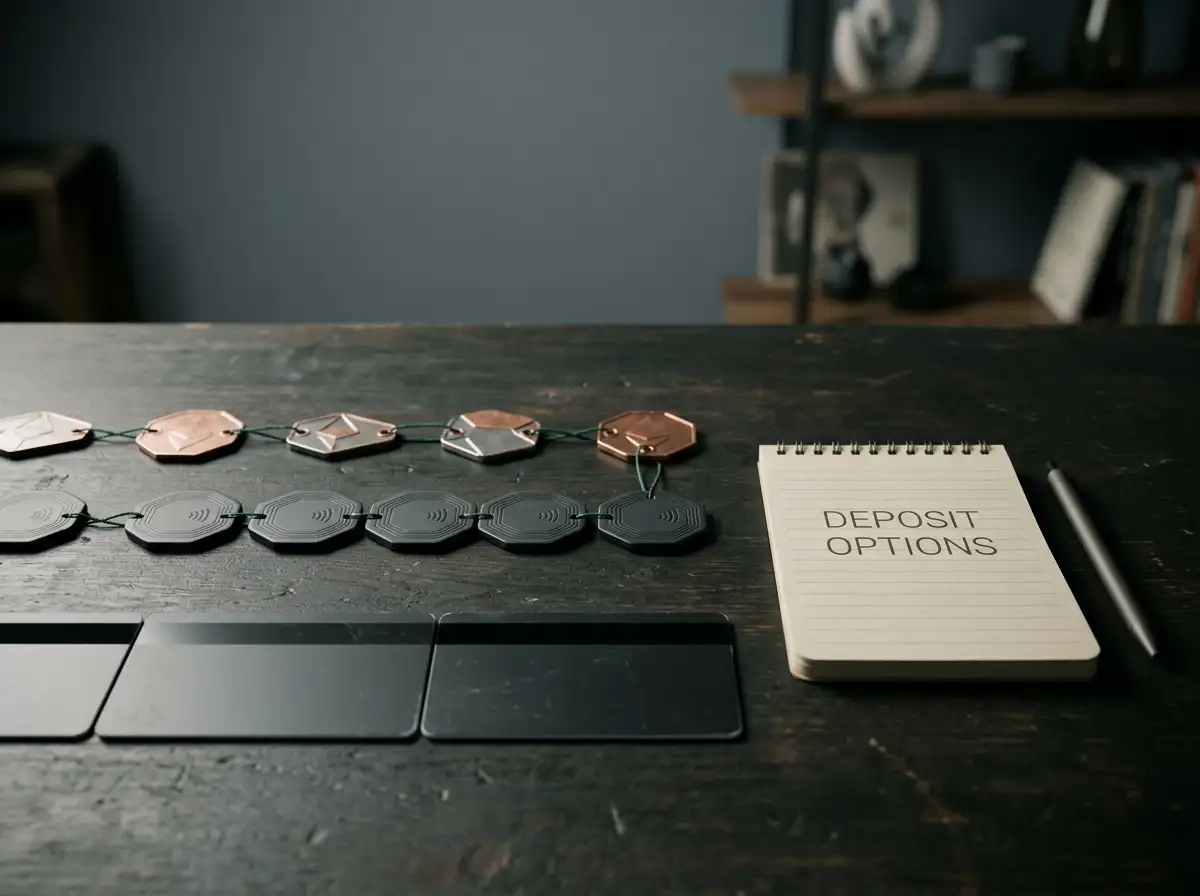
WinShark Casino payment methods: CAD and cryptocurrency
 Available in US
WinShark Casino combines traditional payment services with digital assets. Canadian-dollar accounts, Interac references, cards, wallets and cryptocurrencies each involve different transaction mechanics. Understanding the route is as important as recognizing the payment name.

Table of Contents
- Cards and Interac occupy different places in the payment flow
- The currency shown on the screen changes the amount at risk
- Bitcoin, Ether, Litecoin and USDT introduce network and price exposure
- E-wallets can separate account movement from banking settlement
- Deposits require separate checks for method, currency and conditions
- Cashout conditions add steps beyond the original payment
- Common questions about WinShark payments
- A payment route is a chain of conditions, not a single icon
Cards and Interac occupy different places in the payment flow
WinShark’s payment-method listings include Visa, Mastercard and Interac, alongside bank-transfer categories, wallets, vouchers and cryptocurrency. Interac is particularly relevant to a Canadian audience because it is described in Canada-facing listings of the casino’s methods. A listed method, however, identifies an available category or advertised option, not a guarantee that every account can use it for every transaction.
A card transaction generally begins with authorization through a card network and the issuer. An Interac-related payment follows a banking flow with its own prompts and confirmation steps. Those differences affect what information a payer sees, who can explain a pending transfer and what might happen when the payment is rejected or returned. They also mean that a card used for a deposit should not automatically be assumed to accept casino withdrawals.
For example, someone with a card denominated in Canadian dollars may see a charge in CAD when the receiving account also operates in CAD. If one side is denominated in another currency, conversion becomes a separate concern. A payment route can be familiar while the final amount remains sensitive to issuer fees, exchange rates or payment-provider conditions. The name of a payment method alone cannot settle those charges.
For detail about depositing by Canadian methods and handling a crypto destination, the WinShark deposit methods guide explains the operational differences without assuming that an advertised payment option is available for all accounts.
The currency shown on the screen changes the amount at risk
Canadian dollars and euros are among the fiat currencies associated with WinShark in independent listings. Other currencies appear as well, but a payment in one currency and an account balance in another must not be treated as equal amounts. Conversion may occur at the issuing bank, payment provider or other part of the transaction chain. Without a current individual quote, a particular exchange rate or spread should not be attached to the casino as a fixed fee.
Consider a deliberately general example: someone budgets C$200, then sees an account figure expressed in EUR. That figure cannot be assessed accurately by comparing the two numbers directly. The conversion rate, any applicable charges and the time of conversion matter. The example illustrates a process; it is not a WinShark-specific cashier rate. A practical budget should account for the amount leaving the original account, rather than only the apparent receiving balance.
Fees need the same careful separation. A sending bank may levy a charge, a payment intermediary may have a conversion spread, and a casino may apply rules connected to the activity attached to an account balance. These are not interchangeable. Review-based discussions of WinShark withdrawals describe possible fees under low-wagering conditions, while other listings describe ordinary withdrawals as having no standard fee. This is why an unconditional “fee-free” label would erase a relevant condition.
There is also a distinction between a payment being accepted and a payout being approved. A transfer can complete technically while a withdrawal request still depends on account review or payment-channel availability. The WinShark withdrawal timing and fees guide focuses on that later stage, including how external review examples should be interpreted.
When comparing two methods, write down the currency sent, the currency expected and which part of the transaction could add a charge. A numerical comparison based only on the headline deposit value can conceal meaningful differences in exposure.
Bitcoin, Ether, Litecoin and USDT introduce network and price exposure
Bitcoin (BTC), Ethereum (ETH), Litecoin (LTC) and Tether (USDT) are among the cryptocurrency options identified in WinShark payment listings. Their presence helps explain why the casino is described as combining conventional and crypto methods, but it says nothing by itself about which blockchain networks are offered for a particular account, the fee charged by the casino, or the withdrawal method available to an individual player.
Crypto transfers have at least three separate variables: the quantity of the asset, the receiving address and the blockchain network used. A coin name does not always identify every network option. USDT, in particular, may be available on different blockchain infrastructures in the wider market. Assuming a network from a coin label could send funds to an incompatible destination. That is a general network risk, not a description of any specific WinShark cashier configuration.
The Canadian review CasinoCanada gives asset-specific payment examples for WinShark. The deposit minima below are denominated in the asset itself; the withdrawal minima are quoted in Canadian dollars. These are that review’s listings, not guaranteed terms for an individual transaction. The speed column shows deposit time followed by the estimated withdrawal period.
| Coin | Network | Min Dep | Min WD | Speed | Fee |
|---|---|---|---|---|---|
| BTC | Bitcoin native* | 0.00016875 BTC | C$80 | Instant / 1–3 days | 0% listed* |
| ETH | Ethereum native* | 0.0006 ETH | C$80 | Instant / 1–3 days | 0% listed* |
| LTC | Litecoin native* | 0.24 LTC | C$80 | Instant / 1–3 days | 0% listed* |
| USDT | Network-specific* | 10.60 USDT | C$80 | Instant / 1–3 days | 0% listed* |
* Network descriptions identify common native asset systems, not a guarantee that WinShark offers any particular blockchain route; the transaction instructions must match the actual receiving network. The 0% figure is the review’s standard-fee listing, not a promise of fee-free cashout: separate network charges can arise, and other WinShark reviews describe possible fees when deposit wagering conditions are not met. Similarly, “instant” is a published deposit-speed description, while the 1–3-day figure is a cashout estimate that can be extended by verification or processing.
Market value is a further difference from a bank transfer. A crypto balance can change in Canadian-dollar equivalent while a transfer is pending; price volatility may amplify a loss even without additional casino fees. Stablecoin labels are not a promise of zero risk. A transfer is generally irreversible once settled, so an incorrect destination can have consequences that card or bank payment users do not expect.
E-wallets can separate account movement from banking settlement
Skrill, Neteller and MiFinity feature in WinShark’s payment-method descriptions. An e-wallet may sit between a conventional funding source and a casino account. This separation is useful to understand: the wallet operator may have one set of transaction rules, while the casino balance and its withdrawal conditions are governed by another. A label such as “wallet” therefore does not establish one uniform timetable or fee policy.
Some review materials describe wallet-related withdrawals as comparatively fast, including a 0–24-hour example. That is a review-reported timing range, not a measured deadline for every WinShark customer. An operator’s internal approval time, wallet account checks, transfer batching or the need for identity documents could extend the overall experience. Conversely, an electronic credit can be quick in one case without demonstrating that all account requests will have the same outcome.
Payment choice should therefore be understood as choosing a sequence of services, not simply selecting an icon. A transfer involving a wallet may require a wallet login, account verification and a final withdrawal from the wallet provider. The details that matter are transaction direction, actual currency and the applicable provider terms, rather than a promised universal cashout speed.
Deposits require separate checks for method, currency and conditions
A payment list can describe a wide range of routes without guaranteeing that all of them appear in every account. The options relevant to a Canadian user include traditional cards, Interac references, e-wallets and several crypto assets. Those categories should be assessed separately rather than combined into an assumed universal cashier. The method, currency and account context shape what can happen before funds arrive.
There are different published minimum-deposit examples for WinShark in Canadian dollars: C$10 appears in one independent review, while C$35 appears on a separate Canada-facing promotional domain. They should not be compressed into a single advertised minimum. Differences may result from payment method, campaign or account context; the figures alone do not establish which threshold applies to a new transaction. A deposit amount is also not the same thing as a minimum required to initiate a specific withdrawal.
- Identify the actual currency. Distinguish the value charged to the funding source from any separate account currency.
- Identify the transaction route. Cards, bank methods, wallets and cryptocurrencies can require different authorizations or destination information.
- Understand the balance type. Money credited as ordinary funds and money attached to a promotion can be subject to different usage and cashout conditions.
- Assess the irreversibility. A mistaken blockchain transfer creates a different recovery problem from a reversed card authorization.
Promotions add a further distinction. Some bonus offers impose wagering on promotional funds or restrict the amounts that can later be withdrawn. A payment being successful does not itself demonstrate that an attached promotional balance is immediately cashable. For an explanation of how those rules operate mathematically, the WinShark bonus conditions guide
A disciplined comparison does not need a fabricated list of bank limits or blockchain fees. It needs the correct unit for each figure: currency amount, asset amount, network charge, qualifying stakes and possible final withdrawable balance.
Cashout conditions add steps beyond the original payment
Receiving funds from a casino account is not always the reverse of making a deposit. A route advertised for sending value into a balance may not be available for returning winnings. WinShark reviews describe account checks and several payment methods, with different examples for wallets and bank transfers. These examples are useful for understanding the possible stages; they should not be turned into a guarantee that any one route or processing speed is offered to every Canadian player.
A cashout request may first be reviewed by the operator, then transmitted through a third-party payment service, then posted by the recipient’s bank or wallet. Identity verification and account conditions can also be involved before funds leave. If a crypto payout is used, blockchain confirmation is a further step. Labelling all of those stages “withdrawal time” can make a reported figure appear more definite than it is.
Review publications give withdrawal caps in both euro and Canadian-dollar contexts, with different CAD daily figures appearing in different places. Such figures are not interchangeable: a euro-denominated cap should not be silently converted into a Canadian-dollar promise, and conflicting local examples should not be collapsed into a universal limit. A player’s cashout eligibility can also change when funds are subject to an offer’s own conditions.
Fee claims call for similar precision. A charge linked to wagering activity, an ordinary processing fee and a blockchain transaction cost describe different mechanisms. An external review may discuss one of these without making a complete statement about the others. It is the combination of method, balance conditions and final receiving channel—not a single marketing label—that governs the useful comparison.
For financial planning, a withdrawal should be considered available only when it has actually reached the receiving account in usable form. Estimated timing and a pending balance are not substitutes for cash already held elsewhere. This is especially important when deciding how much money can safely be committed to gambling in the first place.
Common questions about WinShark payments
Does WinShark list Interac for Canadian customers?
Interac appears in Canada-facing descriptions of WinShark payment methods. That listing does not establish support for every account, deposit amount or withdrawal direction.
Which cryptocurrencies appear in WinShark payment listings?
Bitcoin, Ethereum, Litecoin and Tether are listed among the digital-asset options. A coin ticker does not identify the receiving network or establish one fixed transfer charge.
Are Canadian-dollar deposits subject to one minimum?
Published examples differ by source and context, so C$10 and C$35 should not be treated as one universal Canadian-dollar minimum. A particular amount depends on the actual transaction conditions.
Do deposits and withdrawals use the same method?
Not necessarily. A listed deposit route does not prove that the same route can receive winnings. Processing, identification and the relevant balance conditions can differ.
Are cryptocurrency transfers reversible if an address is wrong?
Blockchain transfers are generally irreversible once settled. Matching the correct asset, receiving address and network is essential; the listed coin alone does not determine the full destination details.
A payment route is a chain of conditions, not a single icon
WinShark combines cards, Interac references, e-wallets and multiple cryptocurrencies in a single broad payment offering. The useful comparison is not simply the number of listed methods. It is the currency being transferred, which part of the chain handles the transaction, which costs are inherent to that route and how account conditions may affect the usable balance.
For Canadian readers, CAD denomination is helpful context but not a guarantee of a particular deposit threshold or withdrawal outcome. Card authorization, wallet settlement, foreign exchange and irreversible blockchain transfers present different financial risks. Treat money committed to gambling as money that can be lost, and use a budget that does not depend on winnings returning at a particular time.
Read next
Written by the editors at Win-shark-ca.org.